
Beside Care vs. Life Alert vs. Wearables: An Honest Comparison
We are going to do this one in the way we wish every comparison post was written. Honestly. With numbers and tradeoffs. Without pretending the other categories do not exist. And without claiming we are the right answer for everyone.
If you came here trying to decide between Life Alert, a smartwatch with fall detection, a sensor system, and an AI summary service like Beside Care, the goal of this post is to send you to the right product, even if it is not us.
The four categories, in one paragraph each
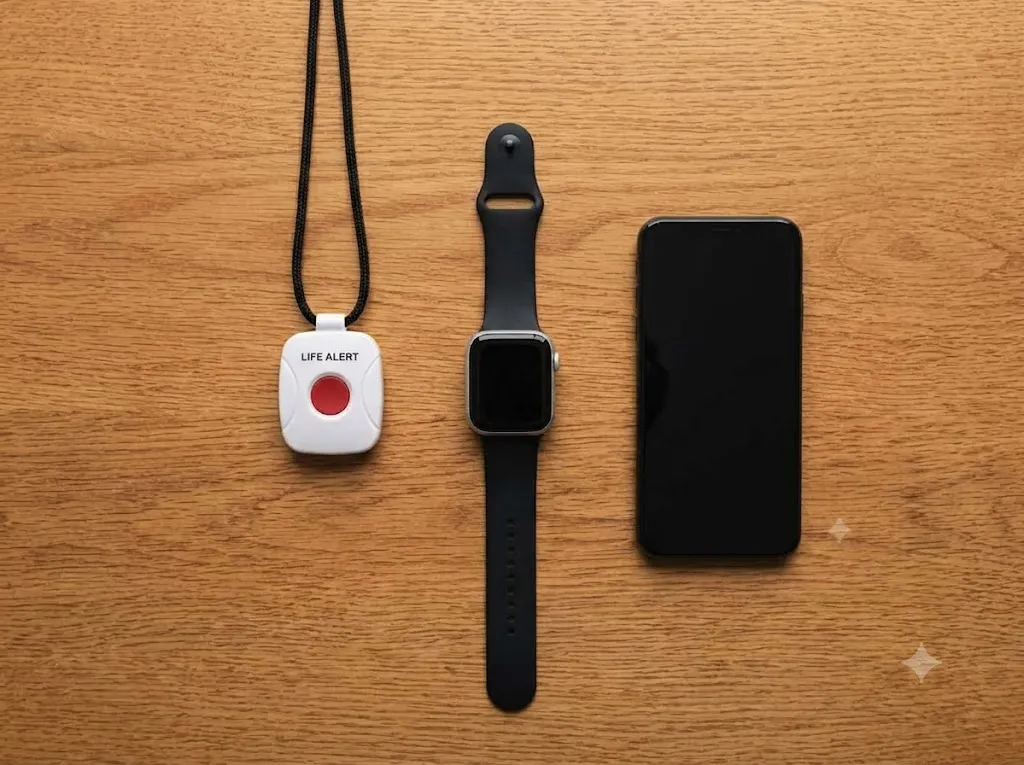
Life Alert and similar pendants are emergency dispatch devices. You wear a small pendant. When you press the button, a call center is contacted and emergency services are dispatched. They have been on the market for decades. Their main value is the call center and the response infrastructure behind it.
Smartwatches with fall detection (Apple Watch, Samsung Galaxy Watch, dedicated senior watches) are wearable computers that can also be alert devices. They detect hard falls automatically, can place emergency calls, and double as fitness and communication tools. The form factor is more socially acceptable than a pendant for many older adults.
Passive sensor systems (in-home sensors at doorways, beds, and appliances) detect activity patterns without requiring anything to be worn. They are privacy-friendly, scale to multi-room coverage, and are best at flagging changes in routine. Installation is more involved than the other categories.
AI activity summaries (Beside Care and similar) sit on top of devices the older adult already has, often cameras, and turn raw data into plain-language summaries and pattern alerts. There is no new hardware. The system learns the rhythm of the home and surfaces what is unusual.
These are four different products solving four different problems. The comparison only makes sense if you start with the problem you are trying to solve.
What each one is actually best at
Same four categories, scored on the only three things that matter when you are choosing: what it nails, where it falls down, and what it costs.
Life Alert and pendants.
Best at direct emergency dispatch, the moment the older adult presses the button. Worst at compliance, slow drift, and dignity. Typically $30 to $50 a month.
Smartwatches.
Best at automatic fall detection and emergency calling, as long as the watch is actually worn. Worst at older adults who never adopt smart tech in the first place. Typically $200 to $500 for the device, plus a plan.
Passive sensors.
Best at pattern detection and rich routine data. Worst at installation complexity, and they give you no visual context. Typically $100 to $400 up front, plus a monthly fee.
AI summaries (Beside Care).
Best at calm, summary-driven awareness using cameras that are already in the home. Worst at direct emergency dispatch, that is not what we do. $20 a month.
The block that matches what you are most worried about is your answer. If your fear is a sudden fall, that points up the list. If your fear is the slow drift, it points down.
When each one is the right answer
You should choose a pendant or smartwatch if:
- Your parent has a meaningful fall risk and lives alone.
- You can answer yes to the compliance question. Will they actually wear it every day, including in the bathroom where many falls happen?
- Your primary need is a fast emergency response.
If you choose this category, smartwatches now outperform traditional pendants for adults who are comfortable with smart tech. Pendants still have a place, especially for adults who specifically prefer them.
You should choose passive sensors if:
- You are willing to invest in a multi-device install.
- You prioritize a no-camera, no-wearable solution.
- You are tracking specific events (bed exits, fridge opens, door activity).
Sensor systems are excellent and underused. The main reason families do not end up here is install complexity.
You should choose Beside Care if:
- Your parent already has Ring cameras in their home.
- Your top concern is the slow drift, not the sudden emergency.
- You want plain-language summaries instead of constant alerts.
- You want to spend zero dollars on new hardware.
- You are not relying on the system for direct emergency dispatch.
You should layer Beside Care with a pendant or smartwatch if:
- You want passive day-to-day awareness, plus an emergency response button for the rare worst case.
- This is the most common setup we see, and it tends to be the best of both worlds.
What we are not
This is the part of comparison posts that nobody usually writes, but it is the part that builds trust.
Beside Care is not an emergency dispatcher. If your parent falls and cannot get up, our system might notice eventually, when expected activity does not occur. That is not the same as a 30-second dispatch. If sudden emergencies are your primary fear, a wearable belongs in the setup.
Beside Care is not a medical device. We are not diagnostic. We do not give medical advice. We describe patterns. We are not a replacement for a primary care visit or a geriatric assessment.
Beside Care does not work without cameras. We read existing camera output. If your parent does not have, or will not accept, a camera in the home, we are not the right fit.
Beside Care is not appropriate for high-acuity care. If your parent has advanced dementia, is at high risk of wandering, or needs hands-on assistance with daily activities, you need a level of support beyond what summary-driven monitoring can provide.
What competitors will not tell you
A few honest observations about the larger category.
Pendant compliance is the silent failure of the wearables industry. Most pendant subscribers wear the device less than half of the time after the first year. The industry knows this. Marketing does not advertise it.
Smartwatches will eat the traditional pendant category over the next five years. Fall detection on Apple Watch and Galaxy Watch is genuinely good. The form factor advantage is real. Pendant companies are pivoting.
Sensor systems are the most over-engineered category. The technology is excellent. The installation friction is high. Most families who would benefit from sensors never get past the setup stage.
AI summary products like Beside Care are early. We are a few years into what we expect will be the default category for slow-drift monitoring. There are still capabilities we do not have yet. We are honest about that, and we ship improvements continuously.
The honest summary
If you can only get one thing, get the one that matches your top fear.
- Fear: a fall, today. → Get a smartwatch.
- Fear: the slow drift. → Get an AI summary service that uses cameras you already have.
- Fear: you do not even know how mom's days are going. → Get an AI summary service.
- Fear: you cannot get them to wear anything. → Skip wearables. Go passive.
If you can get two, layer them. The two we see most often, and the combination we recommend when families ask, is a wearable plus an AI summary service. The wearable handles the emergency. The summaries handle the daily rhythm.
That is the honest version. No category wars. No claims that one product replaces another.
See if Beside Care is the right fit for your family's setup. And next week, we are closing out this 12-week series with the post that started all of this. The one about the question every adult child asks at 2am: "is mom okay?" and three ways to answer it without picking up the phone.
Related posts
- Caregiver Support: When the Responsibility Lands on YouNobody applies for the job of caring for a parent. What the responsibility actually involves, why the emotional weight is heavier than the tasks, and where family caregivers find real support.
- Remote Monitoring for Seniors: What It Is, the Options, and What It CostsRemote monitoring covers five very different products sold under one phrase. What each one actually watches, what it costs over a year, and how families choose when a parent needs more support at home.
- Bed Alarms for Seniors: What They Do, and What They MissA bed alarm answers one question well, and only one: did someone get out of bed and not come back? How they work, where they misfire, and what families usually add next.